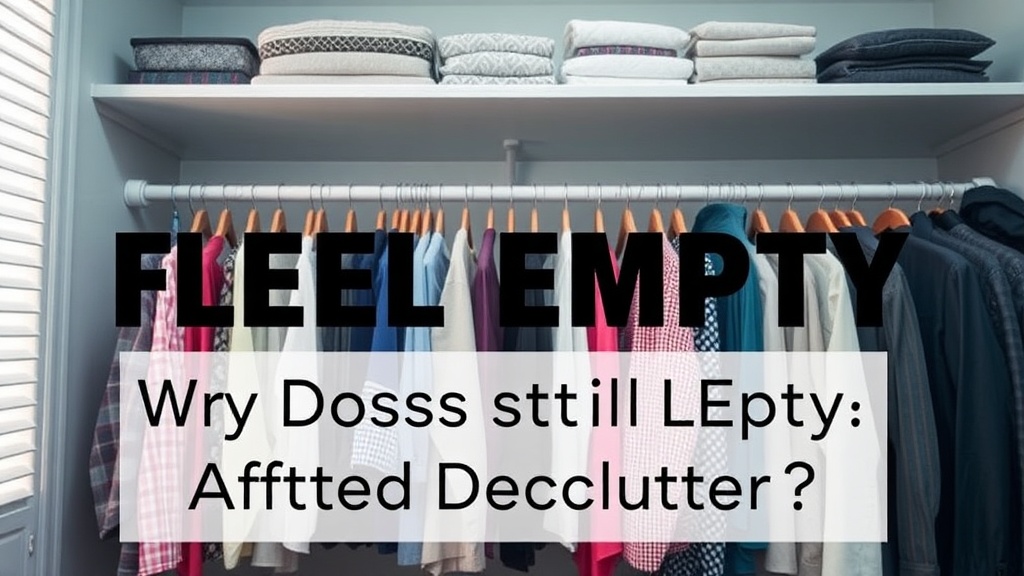
Why Does Your Closet Still Feel Empty After Decluttering?

You open your closet doors, stare at a neat row of hangers, and feel that familiar pang of having nothing to wear. You spent a weekend Marie Kondo-ing your life—donating bags of clothes, folding everything into perfect rectangles, maybe even buying matching velvet hangers—and yet, the problem remains. The space looks better, but your daily getting-dressed struggle hasn't changed. What went wrong?
Most people approach decluttering as a subtraction problem. Get rid of stuff, and clarity will follow. But for a wardrobe that actually works, you need intentional addition just as much as ruthless subtraction. It's about building a collection where every piece earns its place—not just because you like it in isolation, but because it connects to other pieces, creates outfits, and fits your actual life.
What Should I Keep When Everything Feels Sentimental?
Here's where most closet purges fall apart. You hold up a jacket you haven't worn in two years and think about the trip to Portland where you bought it. The concert tee from 2019. The jeans from your "skinny phase" that you swear you'll fit into again. Sentimentality isn't a valid reason to keep clothes—it's a recipe for a museum of your past life, not a functional wardrobe for your present one.
The fix? Create a "memory box" (not a closet) for items with genuine sentimental value. Your grandmother's silk scarf belongs there, not crammed between your work blouses. For everything else, apply the one-year rule with a twist: have you worn it in the last year, and does it work with at least three other items you own? If both answers aren't yes, it goes. Period.
This isn't about minimalism as an aesthetic—it's about curatorial discipline. Museum curators don't keep every artifact; they select pieces that tell a coherent story. Your wardrobe should do the same. Ask yourself: what story do I want my clothes to tell about me? Professional but creative? Effortlessly polished? Comfortably stylish? Every keeper should reinforce that narrative.
How Do I Build a Wardrobe That Actually Creates Outfits?
Picture this: you're running late for a breakfast meeting. You grab a white button-down (safe choice), then stare at your pants options. The navy trousers feel too corporate. The vintage Levi's feel too casual. The black jeans... work, but you've worn that exact combo three times this week. You have clothes—you don't have options.
The solution is thinking in "outfit formulas" rather than individual pieces. A formula is a repeatable combination: oversized blazer + fitted tee + straight-leg jeans. Turtleneck + midi skirt + ankle boots. When you buy with formulas in mind, each new piece extends your existing options exponentially instead of sitting as an orphan.
Try this exercise: lay out your favorite pieces on your bed. Now, force yourself to create five outfits from them. Notice which items show up repeatedly—these are your anchors. Notice which pieces never make the cut. Those are the ones eating your closet real estate without paying rent.
Your anchor pieces should be:
- Neutral enough to pair with multiple colors and styles
- Appropriate for your most frequent activities (work, weekends, whatever fills your calendar)
- Comfortable enough that you actually reach for them
- Well-fitted—ill-fitting clothes create decision fatigue
According to research from Harper's Bazaar, women typically wear only 20% of their wardrobes regularly. The goal isn't to own less for aesthetic reasons—it's to push that 20% closer to 80% by ensuring every item has a job.
Where Should I Invest vs. Where Can I Save?
The "buy less, buy better" mantra gets thrown around constantly, but it lacks nuance. Yes, a $400 cashmere sweater will outlast a $40 fast-fashion version. But should you spend $400 on trend-driven wide-leg trousers that might feel dated next season? Probably not.
Here's a practical framework:
Invest in: Outerwear, shoes, bags, and base layers. These items get the most wear, take the most abuse, and are hardest to fake at lower price points. A well-made wool coat or leather boots improves with age. A cheap polyester version looks tired after six months.
Save on: Trend pieces, seasonal colors, and items you wear infrequently. That neon green top for your friend's tropical-themed birthday party? Buy the Zara version. White t-shirts (they stain, they pill, they need replacement)? Go mid-range—Uniqlo, Everlane, similar—and refresh annually.
Quality doesn't always mean expensive, either. Learn to spot construction details: natural fibers over synthetics (though modern tech fabrics have their place), reinforced seams, proper lining, working buttonholes. These markers matter more than brand names. Resources like Vogue's sustainable shopping guide offer deeper dives into recognizing true quality.
How Often Should I Refresh My Wardrobe?
The fashion industry's seasonal cycle wants you in constant acquisition mode. New drops every Friday, "limited edition" collaborations, sale emails designed to trigger FOMO. Resisting this rhythm isn't about deprivation—it's about creating your own, more sustainable cycle.
Try a seasonal review system instead of constant buying. Every three months, assess:
- What worked? Which pieces did I reach for constantly? These reveal your actual style preferences, not aspirational ones.
- What's missing? Not "what do I want" but "what would have solved a getting-dressed problem I faced?" Maybe you needed a lightweight jacket for those awkward between-season days. Maybe your white tees all have stains and need replacement.
- What should leave? Items that didn't get worn, don't fit properly, or no longer feel like "you."
This quarterly rhythm prevents the gradual closet creep that happens when shopping becomes entertainment rather than problem-solving. It also helps you spot patterns: if you keep buying silk blouses but never wear them, maybe your lifestyle doesn't support high-maintenance fabrics. Better to know that before purchasing the fifth one.
Can One Wardrobe Really Work for Every Occasion?
The short answer: no, and that's okay. The "perfect minimal wardrobe" that handles black-tie galas and weekend hiking and office presentations and date nights is a fantasy. What you can build is a core wardrobe that handles 85% of your life, with strategic supplements for the rest.
Your core—the 85%—should reflect your actual calendar, not imaginary scenarios. If you work from home, that means quality loungewear and a few polished tops for video calls, not five power suits "just in case." If you're a parent running between school pickup and coffee meetings, that means washable, put-together pieces that can handle juice spills and client presentations.
For the remaining 15%—weddings, costume parties, ski trips—consider rental services, borrowing from friends, or keeping a small "special occasion" capsule stored separately. The goal isn't to own nothing; it's to own the right things for the life you're actually living.
As the sustainable fashion advocates at Fashion Revolution emphasize, the most sustainable garment is the one you already own—and wear. A closet full of unworn "perfect" pieces is no better than fast-fashion landfill fodder.
The Checklist for a Wardrobe That Works
Building a functional closet isn't about achieving some Instagram-perfect aesthetic. It's about removing friction from your morning routine, feeling confident in what you wear, and stopping the cycle of buy-purge-repeat. Here's your action plan:
- Audit with honesty: Pull everything out. If you wouldn't buy it again today, it goes.
- Define your uniform: Identify 2-3 outfit formulas that feel like "you." Build around these.
- Fill gaps strategically: Shop with a specific problem to solve, not a mood to satisfy.
- Invest wisely: Spend on high-wear items; save on trends and occasional pieces.
- Review quarterly: Regular maintenance prevents future overwhelming purges.
- Separate memory from function: Keep sentimental items, but not in your working closet.
The empty-closet feeling isn't solved by buying more. It's solved by buying—and keeping—better. A smaller, more intentional wardrobe gives you more options, not fewer. Every hanger holds something you actually want to wear. Every morning, getting dressed becomes simpler, not harder. That's the point of all this decluttering work—not a prettier closet, but a easier life.